 |
| Fania Brancovskaja interviewed at the office of the Union of Vilna Ghetto Survivors |

My family with Aunty Betty (sitting second from left) in Vilna, 1928
Wednesday, 22 May 2013
Fania Brancovskaja 91 today
Today it's Vilna Ghetto survivor and former partisan, Fania Brancovskaja's birthday. She has turned 91. At the risk of repeating myself I'll say once again how much it is a great privilege to have interviewed this extraordinary woman (see Second Visit To Lithuania and Third Visit To Vilnius). She has enriched my life with her positive outlook on her's, despite everything she has been through. If you are curious to know more about Fania's story, here is a link to her biography.

Saturday, 6 April 2013
Third visit to Vilnius

Like a fragment of a Chagall painting the wintry Lithuanian countryside approached at breakneck speed as my flight descended on the capital city. My third trip to Vilnius was a two-day visit with the aim of recording more interview material, filming city sights and doing archival research.
Day 1
 |
| The Gediminas Tower |
 |
| The Vilnia River |
 |
| Sudervės Jewish cemetery |
 |
| Monument to the victims of the ghetto |
 |
| Monument at the entrance to the former Užupis cemetery |
 |
| Bilike Hayzer flats with the monument to Major Plagge in the foreground |
Day 2
The first part of the day was dedicated to a visit to the Lithuanian State Historical Archives on the aptly named Gerosios Vilties (Of Good Hope) Street, number 10. |
| Lithuanian State Historical Archives |
How wonderful it was to see the 90-year-old Fania Brancovskaja that afternoon. It was once again a privilege to interview this former partisan for a second time. The first interview (see "Second visit to Lithuania") had as main theme the forming of and life in the Vilna Ghetto. This second interview had a very different character than the first.
 |
| Fania Brancovskaja |
I took some photographs and books to the interview to show Mrs Brancovskaja. Two of the books, Dos Geystike Ponem Fun Geto (The Spiritual Face of the Ghetto) and Mentshn Fun Geto: Dertseylungen Fun Der Daytsher Okupatsye (People of the Ghetto: Stories of the German Occupation), written by Abraham Ajzen and published in 1949 and 1950, particularly interested her.

[1] The World Of My Parents: Reminiscences, Dina Abramowicz, Yivo Annual Volume 23
[2] http://en.wikipedia.org/wiki/Jewish_cemeteries_of_Vilnius
[3] http://www.untilourlastbreath.com/Bart4liberationfacts.html
[4] http://www.jewishvirtuallibrary.org/jsource/judaica/ejud_0002_0020_0_20424.html
[5] http://www.yadvashem.org/yv/en/righteous/stories/plagge.asp
Sunday, 9 December 2012
War, Peace and Svintsyan
 |
| Cover of the first edition of War and Peace [source: wikimedia.org] |
Following the retreating Russian army at the end of June 1812, Napoleon took the same road into the heart of Russia. Having difficulty crossing the River Kuna, he also stopped with his troops in Svintsyan. The house below, opposite the Orthodox church on Vilniaus gatvė (Vilna Street), was unfortunately not preserved. From this house Napoleon watched his troops pass by, not knowing the disaster that was to befall him and his mighty army later on in that fateful year.
*Barclay de Tolly was notably a Lithuanian nobleman of Scottish descent.
 |
| Napoleon's House [source: JewishGen.org] |
 |
| The Orthodox Church still stands as a silent witness to war and peace [source: The Aunty Betty Project] |
Monday, 26 March 2012
Second visit to Lithuania
Fania Brantsovskaya
Just back from Vilnius and my second trip to Lithuania. During this trip I interviewed Fania Brantsovskaya, Vilna Ghetto survivor and former partisan. It was an honour to meet this extraordinary, energetic 89 year-old woman who, despite all she has been through, emanates an inspiring humaneness and warmth. Mrs Brantsovskaya was able to tell me about life in the Vilna Ghetto in the most incredible and often harrowing detail. She and her family lived in the same street as Feigl, Leib, Basia and Rasza Daiches during the Vilna Ghetto period (see Vilna Ghetto and Ponar). Mrs Brantsovskaya survived by escaping the Ghetto to join the Jewish partisans in the neighbouring forests. No other members of her immediate family survived. This she made clear when she showed me the photo of her family which she keeps on a cabinet in a central spot in the living room. My sincere thanks go to Judita Glauberson who did the Russian-English interpreting for this interview. |
| Fania Brantsovskaya, survivor of the Vilna Ghetto and former partisan |
Svintsyan
The second highlight of the trip was a visit to Svintsyan, or Švenčionys as it is known in Lithuanian, the small town or shtetl my family came from before they moved to Vilnius. A chapter about Svintsyan will appear soon on this weblog. |
| Jewish cemetery in Švenčionys. |
I had read that the three synagogues of Svintsyan had been destroyed and I didn't expect to find anything regarding the rich Jewish past of this rural town 84 kilometres from the Lithuanian capital. It was therefore all the more surprising to find such a beautiful old Jewish cemetery aged by time but undisturbed by history. There were too many graves to search for the family name in the time we had but nevertheless it is a very special feeling to know that my ancestors are buried here.
Family-related landmarks of Vilnius
As if these highlights weren't enough I also found the house that Feigl Lulinski lived in before she married Leib Daiches, number 18 Jono Basanavičiaus Street (then 16 Wielka Pohulanka Street) in Vilnius. This happens to be the same block of apartments in which the famous French writer, diplomat and WWII aviator, Romain Gary lived before he and his mother emigrated to Nice. Part of his novel 'La Promesse de l'aube' describes his childhood in Vilna.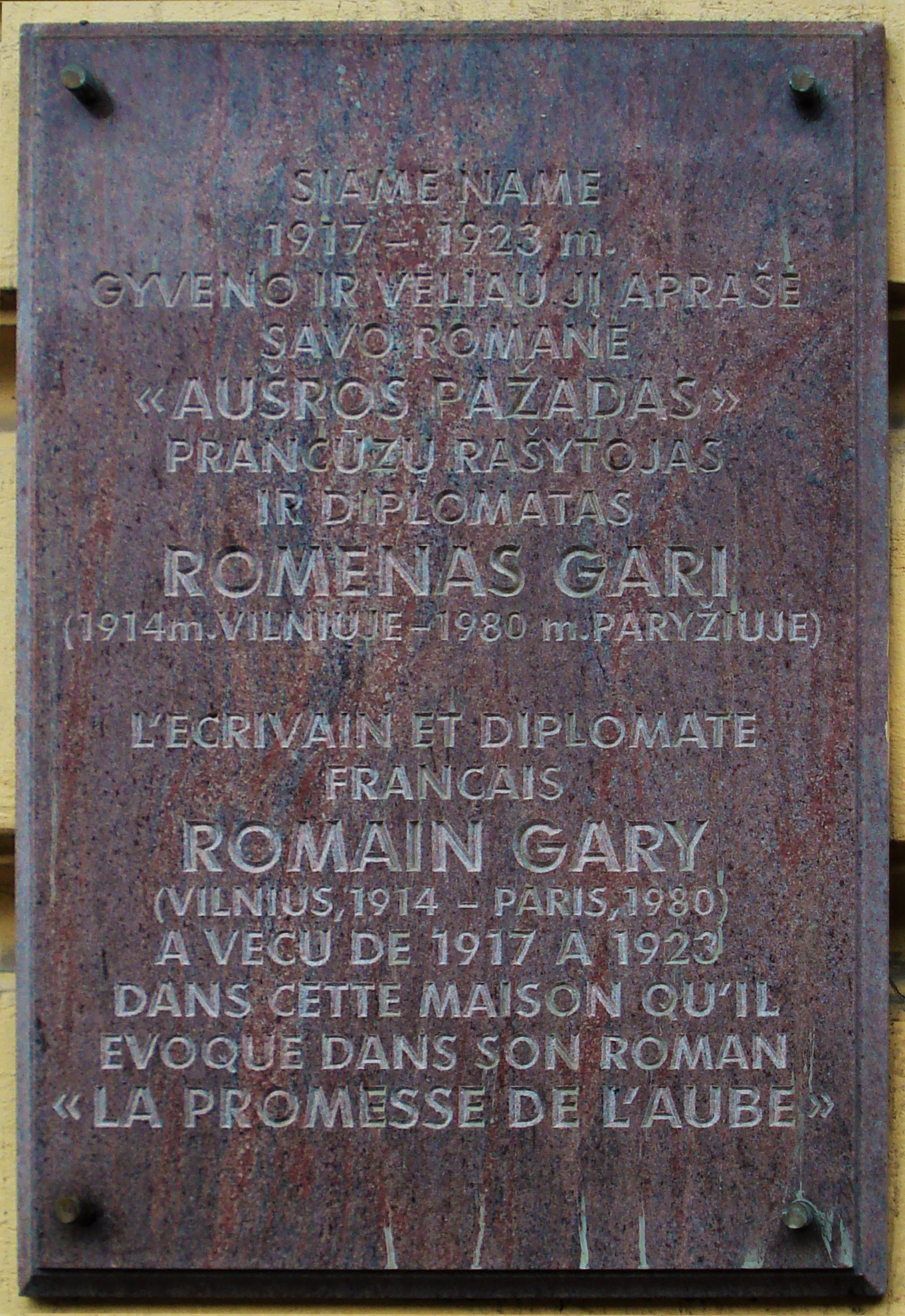 |
| Plaque on 18 Jono Basanavičiaus Street in memory of Romain Gary. |
I also found the apartment block in which Betty's brother Sydney Lubin (Zelik Lulinski) and sister-in-law Sara lived before they left Vilna, incidentally in the same year as Romain Gary, in 1923.
 |
| 14 Savičiaus Street (formerly 14 Sawicza Street [unreferenced]) |
Sara Lulinski was a sewing teacher in the Hilf Durkh Arbet (Help Through Work) institute run by the Yiddish educator, writer and journalist, Hirsz Abramowitz. Situated on a hill overlooking the city I have come to be very fond of, the former Hilf Durkh Arbet building stands on the Subačiaus Street (formerly 19 Subocz Street).

Mrs Brantsovskaya knew this institute well and told me that her aunt had received sewing lessons there.
A number of these details will be compiled into the chapter "Vilna, Wilno, Vilnius". So please don't forget to come back to the weblog once in a while to see how things are progressing.
Friday, 10 February 2012
Promo trailer
With the film footage I've gathered so far I've started work on a 5 minute promotional trailer. This short film will give an impression of the atmosphere, style and theme of the film. I'm really excited about this. All the more so because what started off as an idea, a dream, is starting to become a reality as I mix, cut and shape the footage to tell this story. I can't wait to share the results with you all in the coming months.
Tuesday, 6 December 2011
New York
My sister, Luisa and her boyfriend Scott are helping me out again. They're in New York at the moment filming an interview with Norman Cohen and his wife Ethel. Norman is the son of Aunty Betty's sister, Esther. Norman has a treasure of stories to tell about his parents and their generation.

Norman Cohen (photo Laurie Polli)
During the Second World War, Norman served in the American armed forces and fought in the Normandy landings.

Norman Cohen, photo taken after the liberation of in Paris, 1944
This is the second interview made for the documentary. In 2010 I interviewed Bernice Polli and her husband Laurie in Glasgow.

Bernice is the granddaughter of Annie Taylor, standing in the middle in the banner photo above. Ray Taylor, sitting second from the right in the banner photo, was Annie Taylor's daughter and Bernice's mother.
So curious to see how the footage turns out. A big thanks to all the family in New York who are making this happen!
Tuesday, 15 November 2011
Ponar Desecrated
Last July I visited the killing grounds of Ponar (see Vilna Ghetto and Ponar) to pay respects to my family members who had been murdered there by Nazis and their Lithuanian Nationalist collaborators. It was therefore with dumbfoundment, distress and anger that I read a report that this summer the site had been desecrated by anti-Semites.
This report was published on the site, DefendingHistory.com, edited by Dovid Katz, former Professor of Yiddish Language, Literature and Culture at the University of Vilnius and now independent researcher. Originally aimed at the Baltic region, this site attempts to combat holocaust denial, often in it's most subtle forms at all levels including government level in Eastern European countries.
Click here to see the full report
 |
| In Russian: "Hitler was right" |
 |
| Desecrated memorial for Jewish victims |
This report was published on the site, DefendingHistory.com, edited by Dovid Katz, former Professor of Yiddish Language, Literature and Culture at the University of Vilnius and now independent researcher. Originally aimed at the Baltic region, this site attempts to combat holocaust denial, often in it's most subtle forms at all levels including government level in Eastern European countries.
Click here to see the full report
Subscribe to:
Posts (Atom)