My family with Aunty Betty (sitting second from left) in Vilna, 1928

Sunday, 7 May 2017

Aunty Betty's German Passport

Aunty Betty's German passport
In the weblog article "Vilne, Vilna, Wilno, Vilnius" I wrote about the many administration changes that Vilna underwent in its history. A perfect illustration of this is my Aunty Betty's German passport issued to her in Vilna in 1916 during the First World War. In the document it states that Betty's religion was Jewish and that she was a seamstress. It also contains fingerprints from her right index finger. The photograph of her, sitting on a bench in the offices of the German administration in Vilna, is the earliest I have of her.

In his memoirs Hirsz Abramowicz wrote about the First World War period explaining that the Jewish and Polish residents of Vilna alike were afraid of the Russian soldiers. The Cossack soldiers would ransack their houses and beat them. "Everyone was so fed up with the persecution, libellous attacks, and high inflation that nearly all of Vilna wished to be rid of the Russians, having had enough of their barbaric behaviour. The city's residents expected that things could only get better under the Germans." The Russians withdrew from Vilna at the end of September 1915. The Germans were to an extent welcomed as liberators by the Jewish population. The enthusiasm did not last long however under the strict military government of the German administration in which possessions and crops were requisitioned and a simple word out of turn to an official could lead to a beating. [1]

The cover of Betty's German passport with the imperial eagle of the German Empire and 'Pas' (passport) in German and Yiddish
One of the most surprising things about this bilingual German document is that the second language is Yiddish. Abramowicz also refers to this passport issued by the Germans during the First World War. It is a so-called Ostpas which was issued to every citizen ten years of age and older in the eastern provinces of the German Empire. Betty was 14 when she received hers. The passports were printed in German and Yiddish for those of Jewish "nationality", in German and Lithuanian for ethnic Lithuanians and I would assume also in German and Polish for the ethnic Polish citizens. [1], [2]

Betty's German passport is not just a personal document. I find it a curiosity in itself; a frozen piece of lesser-known history, testifying to just a fragment of the turbulent history of Vilna and its residents.

[1] Hirsz Abramowicz, Profiles of a Lost World - Memoirs of East European Jewish Life before World War II, Wayne State University Press, Detroit, 1999
[2] Howard Margol, Lithuania Internal Passports Database 1919 - 1940, www.litvaksig.org, 2004, 2007, 2011, 2012

Saturday, 25 February 2017

Visit to New York and New Jersey


Statue of Liberty with the Manhattan financial district in the background

In the beginning of the 20th Century part of my Aunty Betty's Lulinski family emigrated from Lithuania to Scotland and part went to the United States. This past autumn a dream came true and I finally visited New York and New Jersey, meeting my American-born family whom I had only discovered when embarking on this project. This weblog post will give a brief overview of the many events that were packed into the few days of my short visit.

Having landed at Newark Liberty Airport my wife and I were picked up by my cousin, Sandy, and her husband, Saul, who took us to their home in New Jersey. Later we met Sandy's sisters, Joyce and Lynda. The three sisters are descendants of one of Aunty Betty's siblings who emigrated to New York.

Family reunion

Family reunion

A family reunion was planned at Joyce's house. Although can you speak of a reunion when in the case of some we had never met in person before? It's just like how Ethel, the sisters' mother, put it when we embraced each other: "How long has it been? Well a lifetime, I suppose!"

Before the "reunion" though we met up with my cousin, Frances.
Left to right: Frances, myself and my wife, Catelijne

Frances is from the Scottish side of the family. She emigrated from Glasgow in 1965 to the United States. She is a granddaughter of Betty's sister, Annie, my great grandmother (for more about Annie see "Annie and the Gorbals"), and she brought an album with fascinating photos, postcards and letters from the Scottish side of the family.

Sydney's Leather Pouch

During coffee at Sandy's house I interviewed Sandy and Lynda. They told me all about the American side of the family. Sandy gave me a leather pouch. It was one of the few belongings which Aunty Betty's brother, Sydney had taken over with him from Vilna. It contains a number of papers, mostly in Polish because Vilna was in Polish hands at the time, which were connected to his journey to the United States.
Sandy and Lynda

Sandy showed us a family video taken in the early years of her and her sisters' childhood in the early 50s. Aunty Betty's brother and sister feature in this film.

Interview Ethel

For the Aunty Betty project my sister interviewed Norman and Ethel Cohen in 2011 (click here for the article "New York"). Norman Cohen is a 2nd generation descendant of the American branch of Aunty Betty's family. Sadly, in the meantime Norman passed away before I was able to meet him in person. I did however meet his wife, Ethel, at the family reunion. The day after the reunion I had the opportunity of interviewing Ethel at her retirement home in New Jersey. In this interview Ethel shed more light on what was often not an easy life for her husband Norman and his parents, who were first generation immigrants to the United States.
Ethel Cohen
One particular anecdote which stood out was the following. Norman's father, Sam Cohen, died when Norman was a child. To help his mother make ends meet, Norman would go to the theatres on Broadway to collect autographs of the stars on postcards. He and his mother would then sell these postcards to bring in some extra money into the household. One particularly famous autograph which Norman acquired was that of George Gershwin.

Ira Lulinski

It was a pleasure and an honour to visit Ira Lulinski and his wife at his daughter's home in New Jersey. Ira (Israel) Lulinski is one of a handful of survivors of the Jewish community of Miory, a town in Belarus not far from the Lithuanian border and also not far from Svintsyan, where Aunty Betty was born. 
Ira Lulinski

We were trying to find a connection between the two Lulinski families. We haven't as yet found a direct connection but as Jews and both having family from this region I felt a meaningful bond between us. Ira's account of survival is a harrowing one and if you are interested to know more about his story then please see The Holocaust Survivors Project.

New York and Ellis Island

We exchanged the green, gently rolling expanse of Manalapan, New Jersey, with its blinding autumn foliage and pumpkin fields, for the unceasing throb of Hell's Kitchen in New York City, the city that literally never sleeps. I went to Ellis Island to try to experience what it must have felt like for my family to arrive in New York. The view of the downtown Manhattan financial district was awe inspiring and even though the skyscrapers looking onto Battery Park and the Upper Hudson Bay have become even taller than back in the first quarter of the 20th Century when my family arrived in New York, the skyline must have surpassed anything they had seen previously. 

I tried to imagine the sense of excitement that Aunty Betty's brother-in-law, Sam Cohen, must have had when his ship reached Ellis Island. Having seen the Statue of Liberty standing in the Hudson Bay, beckoning to him with the offer of freedom and opportunity, he may have stepped onto Ellis Island with some trepidation, anxious if he would be allowed access to the promised land.
The former Registry Hall, Ellis Island

Part of our planned itinerary was to visit the graves of Esther and Sam at Mount Carmel Cemetery. My cousin, Lynda, took us to the cemetery. The cemetery covers a huge expanse of land with roads traversing it. Unfortunately, parts of the cemetery were closing as we drove around like mad people trying to find access to the right area before it closed. The cemetery is a fascinating mirror of the multicultural melting pot that is New York. We stopped to ask the way at a large group of Afro-Americans tending to the grave of a young man. We passed Serbian graves in Cyrillic. We passed the Greek section and the Chinese section. And we passed one Jewish section after another. We had to give up at a certain point when closing time had long passed and there was no more hope of entering the right section. The strong family bonds we re-forged during this visit were more than enough reason to return to New York but if I needed any further reason then it would be to see these family graves.

Workmen's Circle

Aunty Betty's brother-in-law, Sam Cohen, was buried by the Workmen's Circle in a special plot for Workmen's Circle members. Sam was a member of the Workmen's Circle and I was curious to know more about this Jewish labour organisation which still exists and thrives to this day. We were kindly granted an interview with the Workmen's Circle's current Executive Director, Ann Toback.
Ann Toback, Executive Director Workmen's Circle

With enormous enthusiasm and bubbling passion Ann described to me the workers' organisation's past and its relevance to the future of the struggle for social and economic justice in the United States and beyond. The fuel of this movement as Ann explained was and still is "Yiddishkayt" or in other words elements of Jewish life imported by Ashkenazi Jews from Eastern Europe. She named Jewish food and the Yiddish language in particular as important aspects of this culture. As a European Jew I was struck indeed by the vibrant presence of Jewish life in New York, for example in the food but also in the Yiddish language itself with which Saul, Sandy's husband, whom I mentioned in the beginning of this post, was brought up and which he still speaks.
Yonah Schimmel's Knishery (Knish: Jewish filled dough snack from Eastern Europe)

Afterword

I unfortunately did not manage to see all my family in the United States. I would however like to thank everybody we met on this trip for their hospitality and warmth. We felt extremely welcome. This visit was without doubt an intense experience to remember for the rest of my life and in the coming months I hope to write at greater length on this weblog about the interesting material that I have gathered during this trip.

Friday, 26 February 2016

New chapter added: Prisoner 332, Klooga, Estonia

Aunty Betty's niece, Basia Daiches z''l, may her memory be a blessing
Once again a new chapter has just been added to the weblog bringing the project research and filming phase a step closer to completion. Aunty Betty's neice, Basia Daiches, was taken from the Vilna Ghetto to a Nazi labour camp in Estonia. This page tries to reconstruct her story from the little information available, describing the camp and its conditions and relating the dramatic events leading up to the slaughter of the camp inmates on 19th September 1944. To read more please click on "Prisoner 332, Klooga, Estonia" or see the list of chapters on the right.

Friday, 12 December 2014

New chapter added: Annie and The Gorbals of Glasgow


A young Annie Cohen
A new chapter has just been added to the weblog. This page tells the story of the arrival to Glasgow of Betty's sister, my great-grandmother, Annie Cohen in 1904 and gives a brief sketch of Jewish life in Glasgow at that time. To read more please click on "Annie and the Gorbals of Glasgow" or see the list of chapters on the right.

Thursday, 13 November 2014

More than 3000 views and time for some thank yous!

Aunty Betty dressed as a geisha

This weblog has now reached more than 3000 views. Of course the weblog viewers are anonymous. However, Blogger gives me stats on where you, the audience, come from. I thought it might be interesting to share this with you.

The top 10 countries are:

CountryNumber of page views
United States1085
Netherlands657
United Kingdom210
France166
Lithuania91
Germany84
Russia75
Canada71
Taiwan68
Ukraine38

Other countries from which readers have viewed include Belgium, Iraq, Poland and Sweden.

After starting this weblog in 2010, by far the most visited page is "Vilna Ghetto and Ponar" which highlights the tragic side of my family's story. I aim however with this blog to also piece together Jewish life in the different countries of the diaspora in which my family lived. After a "sabbatical," as one of my cousins called it, of a year there are new installments on their way. Almost all the present-day photographs used in this weblog come from video material which has been shot in Lithuania, the United States, Scotland, The Netherlands and Namibia. Despite the huge undertaking it is still my intention to craft the material together to make a documentary film, something I expect to take another few years.

My sister, Luisa, and her boyfriend, Scott, interviewed Norman Cohen in 2011. Sadly Norman will not be able to see the end-result as he passed away in September of this year. His invaluable account of the family and his war years is thankfully recorded on video.

So many people have helped me thus far with the project. But why wait for the closing titles of the film? I'd therefore like to take this opportunity to thank everybody who has contributed to this project so far.

First and foremost I'd like to thank my wife, Catelijne, for researching, filming, translating, interpreting, reviewing weblog posts, helping me to develop the general concept of the project and for her eternal and unwavering support.

I'd also like to thank:

Vilna Gaon State Jewish Museum, Vilnius, Lithuania
Scottish Jewish Archives Centre, Glasgow, Scotland

for supporting this initiative.

I'd like to thank:

Fania Brancovskaja
Norman and Ethel Cohen
Annie Douglas
Harvey Kaplan
Bernice and Laurie Polli
Carole Riato

for allowing me to interview them.

I'd like to thank:

Scott Driskill and Luisa Riato

for interviewing and filming on location.

I'd like to thank:

Diana and Phillip Kay
Giuseppe Riato
Lynda Spinner

for providing assistance on location.

I'd like to thank:

Sofia Chodzinska-Sillevis
Judita Gliauberzonaitė
Natalia Jegudina
Ruben Verhasselt

for providing translation or interpreting services.

I'd like to thank:

Irina Cerneckaitė
Milda Jakulytė-Vasil
John Steegh
Harrie Teunissen

for helping with historical background information or research queries.

I'd like to thank:

Elaine Grae
Diana Kay
Frances Barnett
Jeffrey Barnett
Bernice Polli

for providing family photo and video material or information.

I'd like to thank:

Ron Woloszczuk

for film imagery advice.

I'd like to thank:

Sandy Dalziel

for technical help with the weblog html.

I'd like to thank:

Frances Barnett
Etan Fisher
Joyce Freeman
Annemarie Haest
Diana and Phillip Kay
Laurie and Bernice Polli
Carole Riato
Giuseppe Riato
Peter Sanderson and Saskia Plompen
Mascha Sillevis
Lynda Spinner
Martine Taylor
Frank and Linda Taylor
Sandy Ziss

for donating to The Aunty Betty Project Fund or providing books or other materials.

I'd like to thank:

The Aunty Betty Project Blogger and Facebook friends and readers.

And last but by no means least I'd like to thank my children, Mila and Dante, for putting up with my "obsession" ;-) for all these years. I dedicate this work to them, their generation and the generations to come.

I thank you all from the bottom of my heart!!

Sunday, 13 October 2013

Vilne, Vilna, Wilno, Vilnius

When I was a child, if ever the origins of the family were mentioned in conversation, and that wasn't often, I heard a different country named each time. The one time we came from Russia, they next we were from Poland and yet another time our family came from Lithuania. Rather confusing for a youngster growing up in Scotland. My family came from a number of places in modern-day Lithuania and Belarus but nowhere are the above claims more true than with regards to Vilnius. Vilnius was a prized and heavily disputed city of the Baltics. For the Lithuanians, Vilnius is the historical seat of their ancient kings. The Germans referred to it as "the jewel of the Polish crown". For the Jews, Vilnius was an important spiritual centre of Rabbinical Judaism which earned it the title Yerushalayim de Lite (Jerusalem of Lithuania). 'Jerusalem of Lithuania' has a strange ring to it in the context of modern-day Lithuania. However one has to realise that this was a term coined when Vilnius was part of the Polish-Lithuanian Commonwealth, an empire stretching all the way from Estonia almost to the Black Sea coast of modern-day Ukraine, a territory of more than 1million square kilometres.

Betty's sister, Esther, with Esther's husband, Sam. This photo was taken around the turn of the century when Vilnius was part of the Russian Empire. In Cyrillic the name of the photographer, A. Tsinovets, Vilna [collection Diana Esptein]

Here is an historical timeline of the city of Vilnius charting its turbulent history.

Period Rule Event
6th July 1253 Grand Dutchy of Lithuania Crowning of King Mindaugas
1st July 1569 Polish-Lithuanian Commonwealth Treaty of Lublin
24th October 1795 Russian Empire Third partition of Poland
1915 German Empire First World War
16th February 1918 Independant State of Lithuania Act of Independance of Lithuania 
5th January 1919 Lithuanian Soviet Socialist Republic Soviet Army captures Vilnius
27th February 1919 Lithuanian–Belorussian Soviet Socialist Republic A merge by Soviet authorities to strengthen the two Soviet Republics
21st April 1919 Second Polish Republic Wilno offensive during the Polish-Soviet War
12th July 1920 Independant State of Lithuania Soviet-Lithuanian Peace Treaty
9th October 1920 Republic of Central Lithuania Formation of a state controlled by the Second Polish Republic
20th February 1922 Second Polish Republic Vilnius Sejm vote for Polish annexation
19th September 1939 Soviet Union Invasion of Poland after the signing of the Molotov-Ribbentrop pact
28th October 1939 Independant State of Lithuania Soviet Army withdrawal from Vilnius
21st July 1940 Lithuanian Soviet Socialist Republic Vote by pro-Soviet Seimas to become LSSR
24th June 1941 German Reich Operation Barbarossa
13th July 1944 Lithuanian Soviet Socialist Republic Capture of Vilnius by the Soviet Army
6th September 1991 Republic of Lithuania Lithuania ceded by the Soviet Union

[Source: Wikipedia, compiled by author]

Saturday, 6 July 2013

New information on Betty's nieces

Which minimum set of personal details are appropriate for remembering the deceased? This is a question which has driven me in my search for more information about the family members who were killed during the Second World War. Perhaps a name is sufficient? On the other hand a gravestone usually has a family name, a surname, a date and place of birth and a date and place of death.

When I started researching this project I discovered that many in the family had been named after Betty's two sisters, Dvora and Faigel, who perished in Lithuania. They don't have gravestones on which their names are chiselled. In a way however they do have living memorials embodied in the family members who are named after them.

I don't know what made Aunty Betty submit her testimony in 1977. Yad Vashem started collecting names of victims in the 50s. Perhaps it was an advert in the local Jewish newspaper. In any case when she filled in the forms she didn't know when her sister, Faigel's, daughters died. Moreover she didn't know exactly when they were born and she didn't know or remember their names.


The Lithuanian State Historical Archives got back to me on my search queries which I had submitted during my previous visit. They have found the birth records of Betty's nieces. The spelling of the names is in Polish because Vilnius, or in Polish Wilno, was part of Poland at the time:

Basia daughter of Lejb and Fejga (nee Lulinska) Dajches was born on 28th February 1928 in Wilno
Raisa daughter of Lejb and Fejga (nee Lulinska) Dajches was born on 31st December 1929 in Wilno

Raisa would have been 83 and Basia would have been 85 if they were still alive today. They both lie in mass graves: the one in Ponar, Lithuania; the other in Klooga, Estonia. They have no individual gravestone. I hope with this weblog to create a more personal memorial spot for them.


Wednesday, 22 May 2013

Fania Brancovskaja 91 today

Today it's Vilna Ghetto survivor and former partisan, Fania Brancovskaja's birthday. She has turned 91. At the risk of repeating myself I'll say once again how much it is a great privilege to have interviewed this extraordinary woman (see Second Visit To Lithuania and Third Visit To Vilnius). She has enriched my life with her positive outlook on her's, despite everything she has been through. If you are curious to know more about Fania's story, here is a link to her biography.

Fania Brancovskaja interviewed at the office of the Union of Vilna Ghetto Survivors

Saturday, 6 April 2013

Third visit to Vilnius


Like a fragment of a Chagall painting the wintry Lithuanian countryside approached at breakneck speed as my flight descended on the capital city. My third trip to Vilnius was a two-day visit with the aim of recording more interview material, filming city sights and doing archival research.

Day 1

The Gediminas Tower
In the morning I walked around the centre of Vilnius filming the highlights of this beautiful city. These sites were and are dear to all the ethnic groups who lived as neighbours for hundreds of years in relative harmony. One of the most noteworthy sights is the Gediminas Tower. Once part of a medieval castle complex, the tower, an important symbol of Lithuanian identity, is perched on a hill which rises dramatically out of the city. Dina Abramowicz, the daughter of Hirsz Abramowicz, director of the Hilf Durkh Arbet institute (see "Second visit to Lithuania" for more about Hilf Durkh Arbet) wrote: "As schoolchildren we loved to climb the hill and look down at the panoramic view. Vilna was our city; we loved it and felt at home there." [1] And curiously enough, this in some way mirrors how I felt last year when I visited the Hilf Durkh Arbet building in the Subačiaus Street and looked out over the city.
The Vilnia River
I'm very grateful to my interpreter and good friend, Judita Gliauberzonaite, for taking me in the afternoon to a number of Jewish sites in the suburbs of Vilnius. First of all we went to the Sudervės Jewish cemetery, the current active Jewish cemetery, in the Šeškinė district. Within the bare concrete walls marking the perimeter lies a beautiful cemetery full of tall pine trees, squirrels and woodpeckers. It currently contains about 6,500 graves [2].
Sudervės Jewish cemetery
There one can find the mausoleum in which the remains of the Vilna Gaon, a highly-revered and widely influential rabbi of 18th Century, are kept. There is also a monument to the victims of the Vilna Ghetto. Of the 70,000 Jews of Vilna only 2,500 to 3000 survived the war, between 3 and 4 percent [3].
Monument to the victims of the ghetto
When the old cemetery at Šnipiškės (Yiddish: Shnipishok) was closed by Tsarist authorities a new cemetery was opened at Užupis in 1828. This was our next stop. Both cemeteries were destroyed by the Soviets after the Second World War. The gravestones were used to pave staircases. The monument symbolising the entrance to the Užupis cemetery is made of a number of recovered gravestones.
Monument at the entrance to the former Užupis cemetery
Lastly we visited the Bilike Hayzer (Cheap Houses), a Jewish social housing scheme of the early 20th Century. During the war these blocks of apartments were transformed into the HKP (Heeres Kraftfahrpark) factory, a repair factory for German military vehicles. Here about 3,000 prisoners from the Vilna Ghetto were put to work [4].
Bilike Hayzer flats with the monument to Major Plagge in the foreground
The commanding officer of HKP, Major Karl Plagge has been awarded the title of "Righteous Among the Nations" for his efforts to save Jews. Around 150 to 200 men, women and children managed to survive thanks to his efforts [5].

Day 2

The first part of the day was dedicated to a visit to the Lithuanian State Historical Archives on the aptly named Gerosios Vilties (Of Good Hope) Street, number 10.

Lithuanian State Historical Archives
There I very coincidentally met a man who shares the same surname as Leib Daiches, Aunty Betty's brother-in-law, albeit with a very different spelling. He explained the origins of the name, which he was researching, and it's many spellings. Leib Daiches was a tinsmith. This man explained that his father was also a tinsmith and that he worked on roofs. If he is related to Leib Daiches in any way still remains to be seen. However, he very kindly offered his help to find out more about my family. The Archives are also carrying out research for me. Of course any results will be posted on this weblog.

How wonderful it was to see the 90-year-old Fania Brancovskaja that afternoon. It was once again a privilege to interview this former partisan for a second time. The first interview (see "Second visit to Lithuania") had as main theme the forming of and life in the Vilna Ghetto. This second interview had a very different character than the first.

Fania Brancovskaja
I wanted to know more about Vilna before the Second World War. I learnt from Mrs Brancovskaja about the myriad of Jewish educational, spiritual, artistic and social welfare organisations, about specific Vilna aspects of the Yiddish language, and about the Litvak (Lithuanian Jewish) kitchen. In a one and three quarter hour interview one can only scratch the surface of these subjects, but Mrs Brancovskaja's eyes glittered as she, vivaciously and often humorously, talked about the past that clearly is so dear to her. With this documentary film I want to convey to the public at least a glimmer of the richness and complexity of the Jewish civilization that was built up in difficult times during the interbellum, against the current of history.

I took some photographs and books to the interview to show Mrs Brancovskaja. Two of the books, Dos Geystike Ponem Fun Geto (The Spiritual Face of the Ghetto) and Mentshn Fun Geto: Dertseylungen Fun Der Daytsher Okupatsye (People of the Ghetto: Stories of the German Occupation), written by Abraham Ajzen and published in 1949 and 1950, particularly interested her.

These were books that a friend of mine ordered for me from the Cyco (Central Yiddish Cultural Organisation) Bookstore and Publishing House in New York. Mrs Brancovskaja brought to my attention that the book, People of the Ghetto, was originally published during the war by the Vilna publishing house of Boris Kletzkin which continued publishing until the last years of the war. Seeing how interested she was in the books I gave them to her as a donation to the library of the Vilnius Yiddish Institute where she works as a librarian. Via a roundtrip across the globe, in a way these books had returned perhaps not to their spiritual home but without doubt to their intellectual home.

[1] The World Of My Parents: Reminiscences, Dina Abramowicz, Yivo Annual Volume 23
[2] http://en.wikipedia.org/wiki/Jewish_cemeteries_of_Vilnius
[3] http://www.untilourlastbreath.com/Bart4liberationfacts.html
[4] http://www.jewishvirtuallibrary.org/jsource/judaica/ejud_0002_0020_0_20424.html
[5] http://www.yadvashem.org/yv/en/righteous/stories/plagge.asp

Sunday, 9 December 2012

War, Peace and Svintsyan

Cover of the first edition of 
War and Peace [source: wikimedia.org]
It was on holiday this summer that I unexpectedly stumbled across a reference to Svintsyan, the shtetl (Jewish town) of my forefathers and Aunty Betty's birthplace. I was reading War and Peace when to my astonishment I came across events which took the Russian army through Svintsyan. War And Peace by Leo Tolstoy, a masterpiece of modern literature, cleverly combines the tale of three families, the Bezukhovs, the Rostovs  and the Bolkonskys, with the history of the Russian involvement in the Napoleonic wars spanning the period  from 1805 to 1812. In the summer of 1812 the Russian army was retreating  from the advancing Grande Armée through what is present-day Lithuania, then a Polish frontier region of the Russian Empire. After having retreated through Vilna, Nicholas Rostov and the rest of supreme commander Barclay de Tolly's* troops stopped in 'Sventsyani', the Russian name for Svintsyan. According to Tolstoy's account the Svintsyan encampment was one big drunken orgy: 'many complaints were made against the troops, who taking advantage of the order to collect provisions, took also horses, carriages, and carpets from the Polish proprietors'. In actual fact at least half of the 'Polish proprietors' referred to by Tolstoy were Jewish. The quiet of this tranquil rural town and it's peaceful inhabitants would have been disrupted by the debauchery of hundreds, perhaps thousands of drunken soldiers.
Following the retreating Russian army at the end of June 1812, Napoleon took the same road into the heart of Russia. Having difficulty crossing the River Kuna, he also stopped with his troops in Svintsyan. The house below, opposite the Orthodox church on Vilniaus gatvė (Vilna Street), was unfortunately not preserved. From this house Napoleon watched his troops pass by, not knowing the disaster that was to befall him and his mighty army later on in that fateful year.

*Barclay de Tolly was notably a Lithuanian nobleman of Scottish descent.

Napoleon's House [source: JewishGen.org]
The Orthodox Church still stands as a silent witness to war and peace
[source: The Aunty Betty Project]


Monday, 26 March 2012

Second visit to Lithuania

Fania Brantsovskaya

Just back from Vilnius and my second trip to Lithuania. During this trip I interviewed Fania Brantsovskaya, Vilna Ghetto survivor and former partisan. It was an honour to meet this extraordinary, energetic 89 year-old woman who, despite all she has been through, emanates an inspiring humaneness and warmth. Mrs Brantsovskaya was able to tell me about life in the Vilna Ghetto in the most incredible and often harrowing detail. She and her family lived in the same street as Feigl, Leib, Basia and Rasza Daiches during the Vilna Ghetto period (see Vilna Ghetto and Ponar). Mrs Brantsovskaya survived by escaping the Ghetto to join the Jewish partisans in the neighbouring forests. No other members of her immediate family survived. This she made clear when she showed me the photo of her family which she keeps on a cabinet in a central spot in the living room. My sincere thanks go to Judita Glauberson who did the Russian-English interpreting for this interview. 
Fania Brantsovskaya, survivor of the Vilna Ghetto and former partisan


Svintsyan

The second highlight of the trip was a visit to Svintsyan, or Švenčionys as it is known in Lithuanian, the small town or shtetl my family came from before they moved to Vilnius. A chapter about Svintsyan will appear soon on this weblog.


Jewish cemetery in Švenčionys. 


I had read that the three synagogues of Svintsyan had been destroyed and I didn't expect to find anything regarding the rich Jewish past of this rural town 84 kilometres from the Lithuanian capital. It was therefore all the more surprising to find such a beautiful old Jewish cemetery aged by time but undisturbed by history. There were too many graves to search for the family name in the time we had but nevertheless it is a very special feeling to know that my ancestors are buried here. 

Family-related landmarks of Vilnius

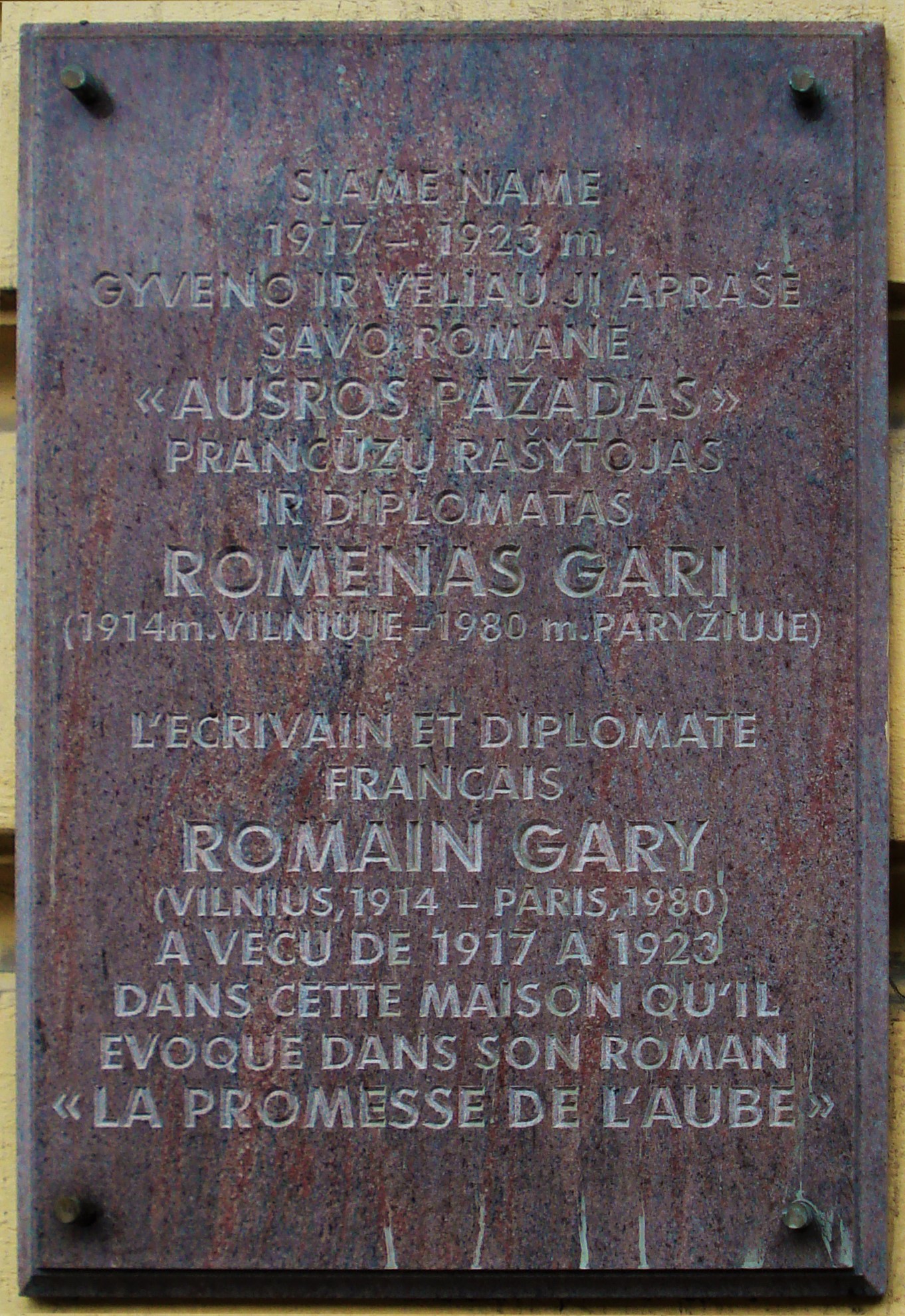
As if these highlights weren't enough I also found the house that Feigl Lulinski lived in before she married Leib Daiches, number 18 Jono Basanavičiaus Street (then 16 Wielka Pohulanka Street) in Vilnius. This happens to be the same block of apartments in which the famous French writer, diplomat and WWII aviator, Romain Gary lived before he and his mother emigrated to Nice. Part of his novel 'La Promesse de l'aube' describes his childhood in Vilna. 

Plaque on 18 Jono Basanavičiaus Street in memory of Romain Gary. 


I also found the apartment block in which Betty's brother Sydney Lubin (Zelik Lulinski) and sister-in-law Sara lived before they left Vilna, incidentally in the same year as Romain Gary, in 1923.

14 Savičiaus Street (formerly 14 Sawicza Street [unreferenced])


Sara Lulinski was a sewing teacher in the Hilf Durkh Arbet (Help Through Work) institute run by the Yiddish educator, writer and journalist, Hirsz Abramowitz. Situated on a hill overlooking the city I have come to be very fond of, the former Hilf Durkh Arbet building stands on the Subačiaus Street (formerly 19 Subocz Street).


Mrs Brantsovskaya knew this institute well and told me that her aunt had received sewing lessons there.

A number of these details will be compiled into the chapter "Vilna, Wilno, Vilnius". So please don't forget to come back to the weblog once in a while to see how things are progressing.

Friday, 10 February 2012

Promo trailer

With the film footage I've gathered so far I've started work on a 5 minute promotional trailer. This short film will give an impression of the atmosphere, style and theme of the film. I'm really excited about this. All the more so because what started off as an idea, a dream, is starting to become a reality as I mix, cut and shape the footage to tell this story. I can't wait to share the results with you all in the coming months.

Tuesday, 6 December 2011

New York

My sister, Luisa and her boyfriend Scott are helping me out again. They're in New York at the moment filming an interview with Norman Cohen and his wife Ethel. Norman is the son of Aunty Betty's sister, Esther. Norman has a treasure of stories to tell about his parents and their generation.


Norman Cohen (photo Laurie Polli)

During the Second World War, Norman served in the American armed forces and fought in the Normandy landings.


Norman Cohen, photo taken after the liberation of in Paris, 1944

This is the second interview made for the documentary. In 2010 I interviewed Bernice Polli and her husband Laurie in Glasgow.


Bernice is the granddaughter of Annie Taylor, standing in the middle in the banner photo above. Ray Taylor, sitting second from the right in the banner photo, was Annie Taylor's daughter and Bernice's mother.


So curious to see how the footage turns out. A big thanks to all the family in New York who are making this happen!

Tuesday, 15 November 2011

Ponar Desecrated

Last July I visited the killing grounds of Ponar (see Vilna Ghetto and Ponar) to pay respects to my family members who had been murdered there by Nazis and their Lithuanian Nationalist collaborators. It was therefore with dumbfoundment, distress and anger that I read a report that this summer the site had been desecrated by anti-Semites.

In Russian: "Hitler was right"

Desecrated memorial for Jewish victims


This report was published on the site, DefendingHistory.com, edited by Dovid Katz, former Professor of Yiddish Language, Literature and Culture at the University of Vilnius and now independent researcher. Originally aimed at the Baltic region, this site attempts to combat holocaust denial, often in it's most subtle forms at all levels including government level in Eastern European countries.

Click here to see the full report

Thursday, 22 September 2011

Yiddish

Last week I started the second year of a beginner's Yiddish language course. It's a small class of enthusiasts who are all connected in at least one thing: a love for the Yiddish language, a language full of character, a language which unmistakably exudes the Jewish, Ashkenazy culture. Unbeknown to my fellow talmidim (students) it was an emotional moment for me when last year I wrote down my first Yiddish words. It was the feeling of suddenly being connected to the past, writing in the language and script of Aunty Betty and my Lithuanian Jewish ancestors. However, besides the emotional connotations there are also practical reasons for me studying what is arguably, the Chassidim aside, a dying language. Aunty Betty and her sweetheart, Joe Frank, corresponded with each other in their mother tongue, Yiddish. My Yiddish teacher has been very helpful in translating theirs and other postcards which have recently come to light amongst the possessions of recently deceased family members.

Joe Frank, South West Africa, 1930's (collection Diana Epstein)


Back of postcard shown above (apologies for the poor quality) 

Kalahari Desert S.W. Africa.
Transcription in Yiddish:
Tsum ondenkung far mayn no’enter un tayerer frayndine fun der vayter Afrika fun dayn gutn fraynd Dzshoh

English translation:
A memento for my close and dear friend from far-off Africa. From your good friend Joe.
(My sincere thanks go to Ruben Verhasselt for this translation)


By learning the language myself, though, I want to be able to decipher these kinds of documents myself. This will be useful for my further research, particularly in Vilnius, where for example many exhibits in the holocaust museum, The Green House, have only explanatory captions in Yiddish and Russian and sometimes in Hebrew.

So I'm looking forward to a new scholastic year and learning this wonderful language.

Sunday, 31 July 2011

Luisa in Namibia

Finally a second post to this weblog of hopefully many to come.

My sister, Luisa, who lives in South Africa, was recently on holiday in Namibia and I asked her and her boyfriend, Scott, if they could take a detour to visit Swakopmund where Aunty Betty allegedly met Joe Frank. This is an account of their visit.


Luisa writes:
"With just under two million people it is also one of the least densely populated countries in the world. Most of Namibia is dusty desert. Strong winds have carved out dunes as high as 300m across the Namib Desert.


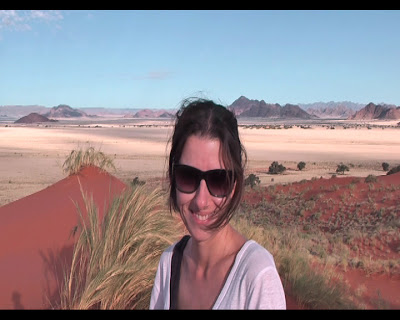
Red dunes of the Namib desert (photo Scott Driskill)


Namibia is one of those dreamlike places with rugged mountains, never-ending plains, remote deserts, wild seascapes, unique wildlife and a diversity of cultures.


Time and space seem less defined here (photo Scott Driskill)


Highly adapted Namib fauna (photos Scott Driskill)

Aunty Betty arrived in Namibia in January 1937. Betty presumably met up in Swakopmund with Joe Frank, who lived and worked there in the late 20’s and 30’s.


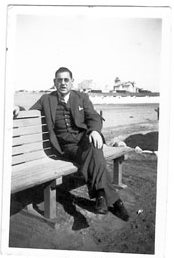
Joe Frank at beach front in Swakopmund, November 1930


Swakopmund today: the lighthouse and museum


Swakopmund (German for "Mouth of the Swakop") is a beach resort and one of the major ports in the region.
Often described as being more German than Germany, Swakopmund is an example of German colonial architecture.


A very well kept, quiet and civilized city, it's a sort of German Largs surrounded by sand dunes! For the non-Scottish readership Largs is an affluent seaside town on the west coast of Scotland.


Outside Swakopmund lies the formidable desert coastline - the Skeleton
Coast. Named for the skeletal shipwrecks and whale bones which litter
endless stretches of foggy beaches."


This was a brief visit to the places of interest related to this project during Luisa's holiday. I hope to send her back to Namibia for a dedicated trip to do more project-related research and interviews.